Guides / Process
Thermal Growth on 5-Axis Machines and How Shops Control It
November 3, 2026
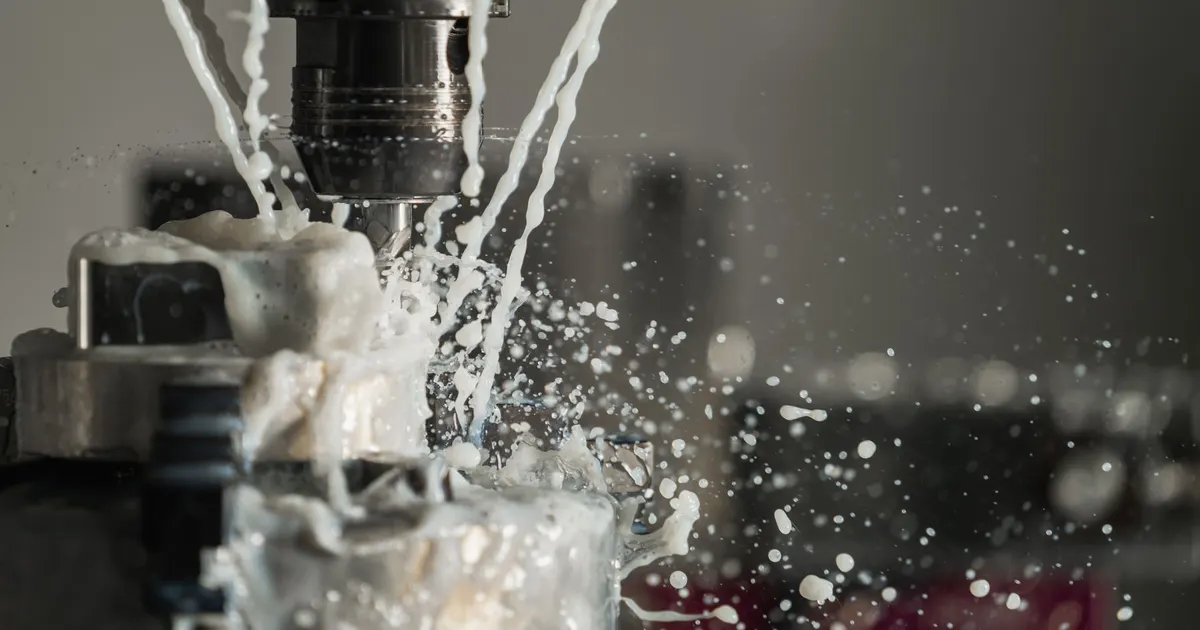
Metal grows when it gets warm. A 5-axis machine is a large steel and cast iron structure with a spindle that heats itself, motors that heat the axes and coolant that carries heat from the cut. All of that changes the position of the tool relative to the part by a few microns to a few hundredths of a millimetre over a working day. For loose tolerances this does not matter. For tight tolerances it is one of the main reasons that the first part in a batch is not the same as the last.
The size of the effect
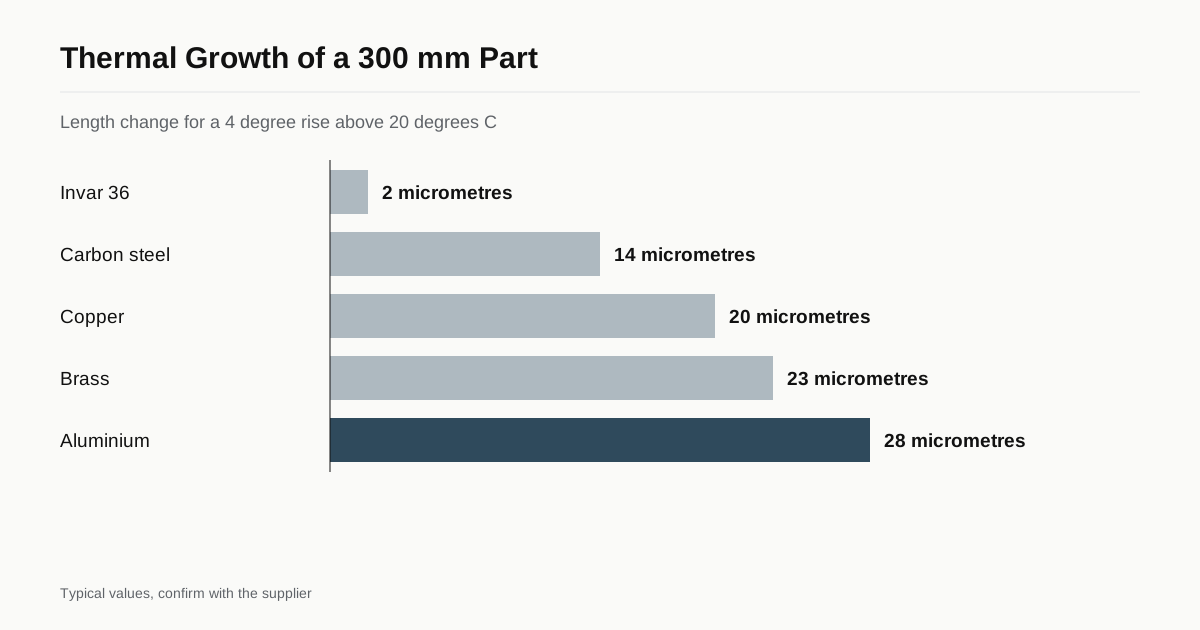
Steel and cast iron expand by roughly 11 to 12 micrometres per metre for each degree Celsius. Aluminium expands about twice as much, at roughly 23 micrometres per metre per degree. These are standard values for the materials, and they let you estimate the effect.
A steel structure 500 mm long that warms by 2 degrees grows by about 12 micrometres. An aluminium part 150 mm long that is 10 degrees warmer than the reference temperature is about 35 micrometres longer. Neither figure sounds large, but on a tolerance of 0.01 mm both would use up the whole band.
Where the heat comes from
| Source | What it does | Typical effect |
|---|---|---|
| Spindle bearings | Spindle grows along its axis | Tool tip moves in Z, often a few hundredths of a millimetre in the first hour without compensation |
| Axis motors and screws | Ball screws and guideways warm up | Position drift along each axis |
| Coolant | Warms the part, the fixture and the machine bed | Part size changes during the cycle |
| Shop air | Day and night temperature changes | Slow drift of the whole machine |
| The cut itself | Chips and tool carry heat into the part | Part is warm when measured |
| Sunlight or draughts | Warms one side of the machine | Uneven growth, hard to trace |
Values depend on the machine and on the load. Confirm with the shop quoting.
Five-axis machines add rotary axes
Rotary axes have their own heat. Drive motors, bearings and the hydraulic or electric clamping of a rotary table warm up with use. Because rotary axes sit between the part and the machine, any growth in their position moves the tilt centre and affects features cut at several angles. A part machined from two or more faces will show this as a small step or mismatch between features that were meant to line up.
How shops control it
Good shops combine several measures, and none of them is exotic.
Warm-up. The spindle and axes run at working speed for a set time before the first cut, commonly in the range of 20 to 60 minutes, so the machine settles at its working temperature.
Cooling. Many machines have chillers on the spindle, motors and sometimes the ball screws, which keep the temperature steady rather than letting it climb.
Temperature-controlled rooms. Shops that do tight work keep the room temperature within a degree or two. Drift between night and day is one of the main sources of error, and a stable room removes much of it.
Software compensation. Controls can use temperature sensors on the machine to estimate growth and shift the axes to compensate. Some controls run a compensation model, others use measured tables from the builder.
Probing during the cycle. The machine measures a reference feature or a fixed sphere on the table, compares the result with the known position and updates the offsets. On long runs the probe repeats this at set intervals.
Part cooling. Washing the part with coolant at a steady temperature before measuring or between operations brings it near the reference temperature.
The measuring side
Dimensions on a drawing are defined at 20 degrees Celsius, the standard reference temperature in ISO 1. A part measured warm reads larger than its true size, and a quality room with a controlled temperature avoids that error. A shop that measures a warm part straight off the machine can reject a good part or pass a bad one. On tight-tolerance work, ask where and at what temperature the part is inspected. Our guide on inspecting a 5-axis part covers the main steps.
What it means for your order
Thermal control costs money, through machine features, room control and slower cycles for warm-up and probing. For most parts you do not need to pay for it. When the drawing asks for tolerances of 0.01 mm or tighter, or for features that must align across several faces, the shop must spend more care on heat, and the price reflects it. Our overview of 5-axis machining tolerances separates what is routine from what needs special care, and the accuracy guide explains the other contributors to error.
Repeat orders also benefit. A shop that has found a stable routine for your part can repeat it, but only if the program, offsets, warm-up and inspection steps are recorded.
A worked example
Take an aluminium housing 300 mm long with a bore position tolerance of plus or minus 0.02 mm. The shop’s room is 22 degrees Celsius at the start of the shift and 26 degrees by afternoon. A rise of 4 degrees changes the housing length by about 0.028 mm, since aluminium expands at about 23 micrometres per metre per degree (23 x 0.3 x 4 = 27.6 micrometres). The machine structure grows too, by a smaller but not zero amount. If the first part is checked in the morning and the last in the afternoon, a tolerance of plus or minus 0.02 mm can be missed with no change at all in the cutting.
The same numbers show why shops measure at 20 degrees and why a few degrees matter more on long parts than on short ones. A 30 mm part shifts by only a few micrometres under the same temperature change, which is why small precision parts are less sensitive than large frames.
Long runs and unattended machining
Thermal drift matters most on long runs. A batch that runs overnight can span a drop of several degrees in room temperature, and the first and last parts can differ. Shops handle this with in-process probing, which measures a feature on each part or every few parts and adjusts the offset, or with a controlled room that removes the swing. A buyer who plans a large batch can ask how the shop keeps the first and last parts alike, and can ask for a first, middle and last part inspection report.
Machine design and thermal behaviour
Machine builders attack thermal growth in the design as well as in software. Symmetric structures spread heat evenly, so the machine grows without bending. Hollow cast structures with cooling channels, linear scales mounted away from heat sources and spindle cooling circuits all reduce drift. Some builders publish thermal test results under a standard method, and a shop can share them for its machines. Buyers do not need to read these reports, but a shop that can produce one understands the issue, and that is useful information when comparing quotes for tight-tolerance work.
What to ask a shop
- Do you run a warm-up routine, and how long is it?
- Are the machines in a temperature-controlled room?
- Do you probe a reference during long cycles to update offsets?
- At what temperature do you measure the part?
- How do you handle features that must align across several setups?
What to send with the RFQ
Mark the tolerances that truly need to be tight and leave the rest at general tolerance. Say which features must hold their position to each other, and give the material, because aluminium and steel behave differently. Use the RFQ form to send the drawing and these notes.
Checklist
- Mark only the critical tolerances as tight.
- Name features that must align across faces.
- State the material, since expansion differs by material.
- Ask about warm-up, room control and in-process probing.
- Ask at what temperature the part is measured.
This post is part of our guide to 5 axis machining quality control.
Frequently asked questions
How much does a CNC machine grow with heat?
It depends on the machine, the warm-up and the room. Spindle growth of a few hundredths of a millimetre during the first hour is common on machines without active compensation. Good machines, warm-up routines and probing reduce that to a few microns.
What is a warm-up cycle?
A warm-up cycle runs the spindle and the axes at working speeds, without cutting, for a set time before the first part. The machine reaches a steady temperature, so the first part and the tenth part come out the same size.
Does thermal growth matter for normal tolerances?
For tolerances of about 0.05 mm or looser it rarely matters. For tolerances of 0.01 mm or tighter it matters a lot, especially on long cycles and on parts cut in several setups. Ask the shop how it controls heat on tight-tolerance work.
Need a quote for this part?
Send the drawing. We match you with up to 3 5-axis shops and reply within 24 business hours.
Get matched with a 5-axis shop