Guides / Materials
5-Axis Machining Copper and Brass: Burrs, Heat and Finish
October 26, 2026
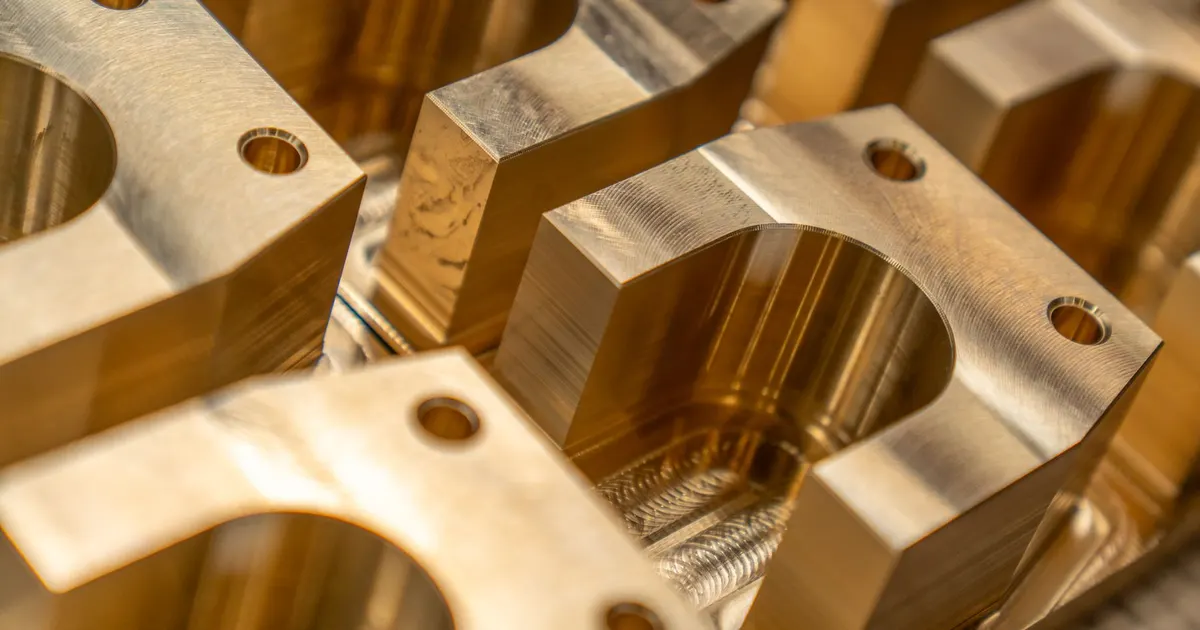
Copper and brass look similar and behave very differently under a cutter. Brass in its free-cutting form is the easiest common metal to machine, and a good shop can run it fast with a bright finish. Pure copper is the opposite: soft, gummy and prone to burrs. A buyer who specifies the alloy carefully gets the right behaviour and the right price. A buyer who writes “copper” on a drawing without a grade invites a quote for the hardest version of the job.
Grades and how they cut
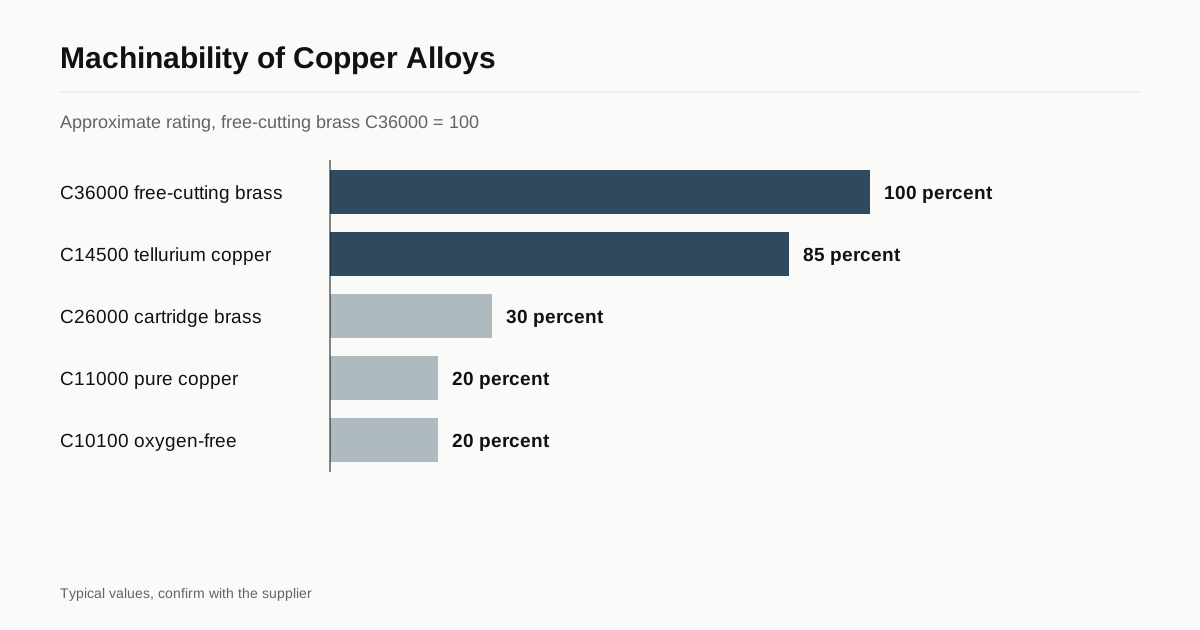
Machinability is often shown as a percentage, with free-cutting brass C36000 at 100 percent as the reference. Published ratings vary a little by source, but the order is stable.
| Alloy | Name | Rating, approx. | Typical use |
|---|---|---|---|
| C36000 | Free-cutting brass | 100 percent | Fittings, connectors, general parts |
| C26000 | Cartridge brass | About 30 percent | Formed and drawn parts |
| C14500 | Tellurium copper | About 85 percent | Conductive parts, welding and EDM parts |
| C11000 | Electrolytic tough pitch copper | About 20 percent | Busbars, heat sinks |
| C10100 | Oxygen-free copper | About 20 percent | Vacuum and RF parts |
| C17200 | Beryllium copper | Varies with temper | Springs, tooling, non-sparking parts |
Treat the ratings as a guide only. The condition of the metal, hard or soft temper, changes the behaviour as well.
Why pure copper is difficult
Pure copper is ductile. The cutter pushes the metal instead of shearing it cleanly, and the chip stays long and stringy. Chips wrap around the tool, scratch the surface and block coolant. The edge of a cut part rolls over into a burr rather than breaking off. Copper also welds to cutting edges and builds up a layer on the tool, which spoils the finish.
Shops manage this with sharp, polished tools with large positive rake, high cutting speeds with steady feed, chip breakers in the toolpath and coolant directed at the cut. In pocketing the toolpath may include retract moves that break the chip.
Heat and expansion
Copper conducts heat very well, about ten times better than stainless steel. Cutting heat spreads through the part, so the edge stays cooler, but the whole part warms and expands. Copper expands about 17 micrometres per metre per degree, brass about 19 to 21. A warm part measured straight from the machine reads larger than it will at 20 degrees, so tight tolerances need cooling time or a controlled measuring room. See thermal growth on 5-axis machines for the details.
Burrs
Burrs are the main finishing job in copper and soft brass. Cutters leave a raised edge on every exit, and in 5-axis work there are exits on many faces. The shop reduces burrs through toolpath design, exit angles and sharp tools. Remaining burrs are removed by hand, by tumbling or by brushing, and any process that touches the part must not round critical edges or remove too much material. On sealing faces and electrical contact faces the drawing should state an edge condition, such as a maximum burr height or an edge break.
Where 5-axis helps
Copper parts such as heat exchangers, RF cavities, welding electrodes and EDM electrodes often have angled ports, curved cooling channels and contoured faces. A 5-axis machine can cut those features in one setup and keep the relation between faces. For thin copper walls, a tilted tool holds a steady contact and reduces the pressure that bends the wall. The guide to 5-axis semiconductor components covers a typical use where oxygen-free copper is common.
Finish and plating
Machined copper and brass can look bright and clean, but both tarnish in air. Parts are therefore often plated or passivated. Common finishes include nickel plating, tin plating, silver plating for RF and high conductivity use, gold over nickel for contacts and clear lacquer or chemical passivation for appearance. Plating shows every scratch and burr, so the machined surface must be better than the final finish. State the finish and thickness on the drawing and see the surface finish guide for ways to write it.
What drives the cost
- Alloy. Free-cutting brass is cheap and fast. Oxygen-free copper is expensive and slow.
- Material price. Copper price changes with the metal market, so quotes may carry a short validity date.
- Burr removal. Hand finishing adds labour.
- Plating. Adds days and an outside vendor.
- Scrap risk. Soft metal is easy to mark when handled.
Tool and strategy choices that help
A few practical choices make copper and brass jobs go well on a 5-axis machine.
- Tools with a high polish. Polished flutes shed chips and reduce built-up edge on copper. Uncoated or specially coated tools are common, because some coatings stick to copper.
- Fewer flutes. Two or three flute cutters leave room for the large chips that soft copper makes.
- High speed, moderate feed. Spindle speed is raised so the tool cuts instead of pushing, and the feed is set to keep the chip thick enough to curl away.
- Climb milling. Cutting with the feed direction leaves a cleaner edge and a smaller burr.
- Air or coolant at the cut. Brass often cuts dry with an air blast, which keeps the chips visible and easy to collect. Copper often takes coolant to carry heat and clear stringy chips.
The correct choice varies by alloy and temper, and a shop with experience will have a starting recipe. A shop that mostly cuts steel may need more time to find one.
Handling and damage
Copper and soft brass mark easily. A part dropped in a bin of other parts gets dents that show on a visible or sealing face. Shops that make good copper parts use separators, soft packaging and clean gloves, and they handle plated parts with care. On parts with a polished or plated finish, one scratch is a reject, so the packaging requirement belongs on the RFQ.
Chips are worth money, and a shop that cuts copper keeps them separate from other metals so that they can be recycled. This does not affect the buyer directly, but it shows how an experienced shop runs the job.
Safety note on beryllium copper
Beryllium copper is a strong, springy alloy used for tools, connectors and non-sparking parts. In solid form it is safe to handle, but dust and fume from machining, grinding or welding contain beryllium and are hazardous if breathed. Shops that cut it follow exposure control rules, with extraction and cleaning, and some decline the work. If your drawing calls for beryllium copper, say so early, and expect a smaller group of shops to quote. Ask about the shop’s controls, and check any rules that apply where you are.
What to send with the RFQ
- The exact alloy designation, for example C11000 half-hard or C36000.
- Restrictions such as lead-free or conductivity requirements.
- Edge condition and burr limits for critical faces.
- Finish, plating type and thickness.
- Whether parts must be packed separately to avoid scratches.
Send the files through the RFQ form and we match them with shops that regularly cut the alloy you named.
Checklist
- Write the alloy designation and temper.
- State any lead or conductivity restriction.
- Give the edge condition for critical faces.
- Name the plating and thickness.
- Ask how parts are packed.
Frequently asked questions
Why is pure copper harder to machine than brass?
Pure copper is soft and ductile, so it tears and forms long stringy chips and large burrs instead of breaking cleanly. Free-cutting brass contains lead or a substitute that breaks chips short, which makes it among the easiest metals to cut.
Which copper alloy is easiest to machine?
Tellurium copper (C14500) and sulphur copper (C14700) were made for machining and cut far better than pure copper while keeping most of its conductivity. Free-cutting brass such as C36000 is the benchmark for easy machining.
Is lead-free brass available for machined parts?
Yes. Lead-free and low-lead brasses exist for water-contact and consumer parts, but they machine less freely than C36000. Say on the RFQ if lead content is restricted, so the shop quotes the right alloy.
Need a quote for this part?
Send the drawing. We match you with up to 3 5-axis shops and reply within 24 business hours.
Get matched with a 5-axis shop