Guides / Materials
Hard Milling on 5-Axis: Machining Tool Steel Above 50 HRC
October 12, 2026
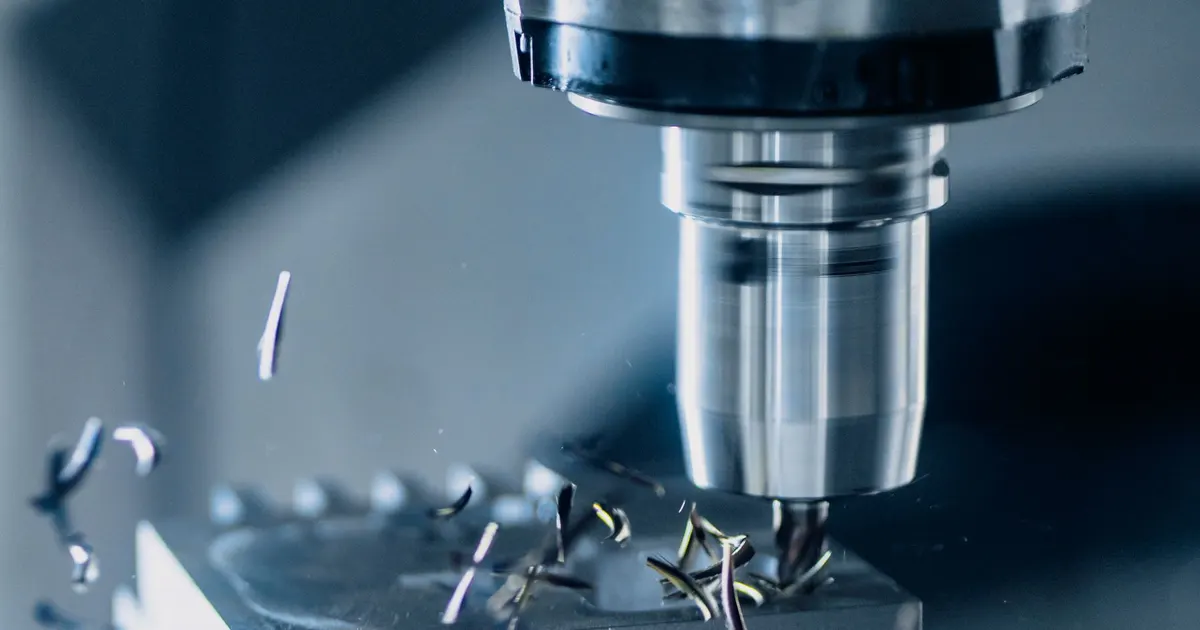
Tool steel is usually cut soft, heat treated and then ground or finished by EDM, because hardened steel destroys ordinary cutters. Hard milling changes that order. The steel is hardened first, typically to somewhere between 50 and 62 HRC, and a fine-grained, coated carbide tool cuts the final shape directly at high speed and light depth. This removes the distortion that heat treatment causes after machining, and it can replace electrodes and grinding on many surfaces. A 5-axis machine makes the process more reliable, because tool angle and reach decide whether a hard cut is stable.
What counts as hard
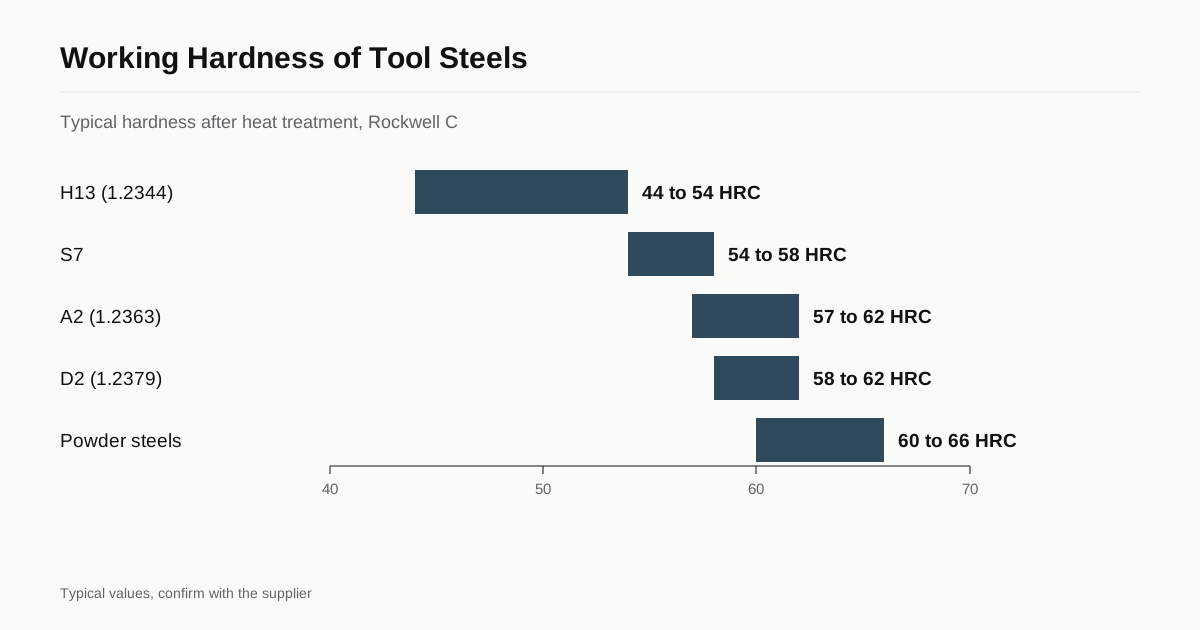
Hardness is measured on the Rockwell C scale, written HRC. Soft annealed tool steel sits around 20 to 30 HRC. After heat treatment, common tool steels reach roughly these ranges, depending on temper.
| Steel | Typical use | Usual working hardness |
|---|---|---|
| H13 (1.2344) | Die casting and forging dies, mould inserts | About 44 to 54 HRC |
| S7 | Shock-resistant tooling | About 54 to 58 HRC |
| A2 (1.2363) | Punches, forming tools | About 57 to 62 HRC |
| D2 (1.2379) | Blanking dies, wear parts | About 58 to 62 HRC |
| Powder steels | High wear tools | About 60 to 66 HRC |
Ranges depend on the specification and the heat treater. Confirm the value on the drawing, with a tolerance, such as 52 to 54 HRC.
How hard milling differs from soft cutting
Tools and parameters change with hardness.
- Tools. Fine-grained carbide with a coating suited to heat, such as an aluminium titanium nitride type. Ball-nose and bull-nose end mills are common.
- Speed and cut. High spindle speed with a very light axial and radial depth, which keeps the load on the tool low and steady.
- Cooling. Many shops cut dry with an air blast, because sudden cooling cracks the carbide edge. Some use mist.
- Stick-out. The tool is held as short as possible. A long tool in hard steel deflects and chatters.
- Machine. The machine must be stiff and accurate at high speed, and the control needs look-ahead to keep feed even through curves.
Cutting data depends on the tool maker, so shops follow the tool supplier’s recommendations and adjust from there. A figure quoted on a data sheet for one cutter will not fit another.
Where 5-axis helps
A ball-nose cutter cuts poorly at its tip because the surface speed there is close to zero. On a flat or shallow surface a 3-axis path puts that dead centre in the cut. A 5-axis machine tilts the tool, often by 10 to 15 degrees, so the cutting edge works at a better speed and the finish improves. Tilting also lets a shorter tool reach into a cavity, and a shorter tool deflects less. In hard steel these two effects combine, and they are the main reason hard milling moved from 3-axis to 5-axis machines for moulds and dies. For related toolpath choices, see 5-axis CAM toolpaths.
Where hard milling replaces other processes
Hard milling can replace some finish grinding and some EDM, but not all.
Good fit. Open sculpted surfaces on dies and mould inserts, shallow cavities, parting surfaces, trim steel and inserts with 3D contours.
Poor fit. Deep narrow ribs and slots, sharp inside corners with no radius and very small features. Those still need EDM, because a cutter has a radius and a length-to-diameter limit. The guide on 5-axis mould machining compares the two routes in more detail.
Heat treatment and distortion
Hard milling is done after hardening, so the part has already moved as much as it will. The shop usually rough machines in the soft state, leaves stock of a few tenths of a millimetre to 1 mm, sends the part for heat treatment and finishes it hard. Stress relief before the final harden can reduce distortion. If the heat treatment is done by a third party, the lead time grows by the transport and process days, so plan for it.
Cost and tool wear
Tool wear is the main cost driver. Cutters wear faster in harder steel, so the shop changes tools more often and may set a tool life limit in the program. Machine time is also longer than in soft steel because the cuts are light. Compared with EDM, hard milling saves electrode making and burning time on open surfaces, and it can finish in the same setup. For buyers, the quote typically shows a higher machine rate, a tool allowance and a lead time that includes heat treatment.
Tool life and process planning
A hard milling job is planned around tool life. The shop selects cutters, runs a test or follows a proven recipe, and sets a tool life limit in the program so that tools are changed before they fail. A worn tool in hard steel does more than leave a poor surface. It can chip and mark the part, and in a finished mould insert a mark can mean a scrapped piece that took days to make.
Typical planning includes:
- A fresh tool for each critical finishing area, so that wear does not show on the visible surface.
- A tool break check using a laser or touch sensor in the machine, which stops the cycle if a tool breaks.
- Roughing with cheaper tools, and finishing with premium tools that stay sharp.
- Constant engagement toolpaths that avoid sudden loading in corners.
For expensive parts the shop may split the finishing into stages so the last cut is always a light one with a new tool.
Quality and finish after hard milling
A hard-milled surface is typically smooth enough to polish directly, but its finish depends on step-over, tool wear and machine stiffness. Typical finishes lie in a range of roughly Ra 0.4 to 0.8 micrometres on well-planned finishing cuts, with finer values possible after polishing. These are indicative figures, so ask the shop what it achieves on parts like yours.
Surface integrity matters on tools that see heavy load. Overheating at the cut can leave a thin, brittle layer, sometimes called a white layer, which may crack in service. Dry cutting with sharp tools, light cuts and good chip evacuation limit the heat. If the part is a long-run die, ask the shop how it controls heat and whether it checks the surface after cutting.
Inspection
Hard-milled inserts are checked on a CMM, often with a scan of the sculpted surface compared with the model, and with gauges for fit features. Matching faces of two mould halves are checked by blueing or by measurement. Our guide on inspecting a 5-axis part explains the main methods. State on the drawing which surfaces are critical, since scanning every surface adds time and cost.
Specifying the job
- The steel grade and the hardness with a range, for example 52 to 54 HRC.
- Whether the part arrives hardened from a supplier or the shop arranges heat treatment.
- Surface finish in Ra for each critical surface.
- Features that need EDM, such as deep slots and sharp corners.
- Tolerances on form and profile, as well as size.
Our guide on surface finish for 5-axis parts explains how to write finish targets. Send the drawing and the 3D model through the RFQ form, and mention the steel grade and hardness in the first line.
Checklist
- Give the steel grade and the hardness range.
- State who arranges heat treatment and when.
- List the features that need EDM or grinding.
- Give a finish target for each critical surface.
- Ask for the tool wear allowance in the quote.
Frequently asked questions
What is hard milling?
Hard milling is cutting steel that has already been heat treated, usually at 50 HRC or harder, with fine-grained carbide tools at high speed and light cuts. It finishes dies and moulds without grinding or EDM on many surfaces.
Why use 5 axis for hard milling?
Tilting the tool keeps a short stick-out and puts the cutting edge on the surface at a good angle, so the tool deflects less, wears more evenly and leaves a steadier finish. Tilting also avoids cutting with the dead centre of a ball-nose cutter.
Is hard milling always cheaper than EDM?
Not always. Deep narrow slots and sharp inside corners still need EDM. On open sculpted surfaces hard milling is often faster than sinker EDM and needs no electrodes, but tool wear in very hard steel is high.
Need a quote for this part?
Send the drawing. We match you with up to 3 5-axis shops and reply within 24 business hours.
Get matched with a 5-axis shop