Guides / Industries
5-Axis Machining Mold Cores and Cavities: When It Beats EDM
October 31, 2026
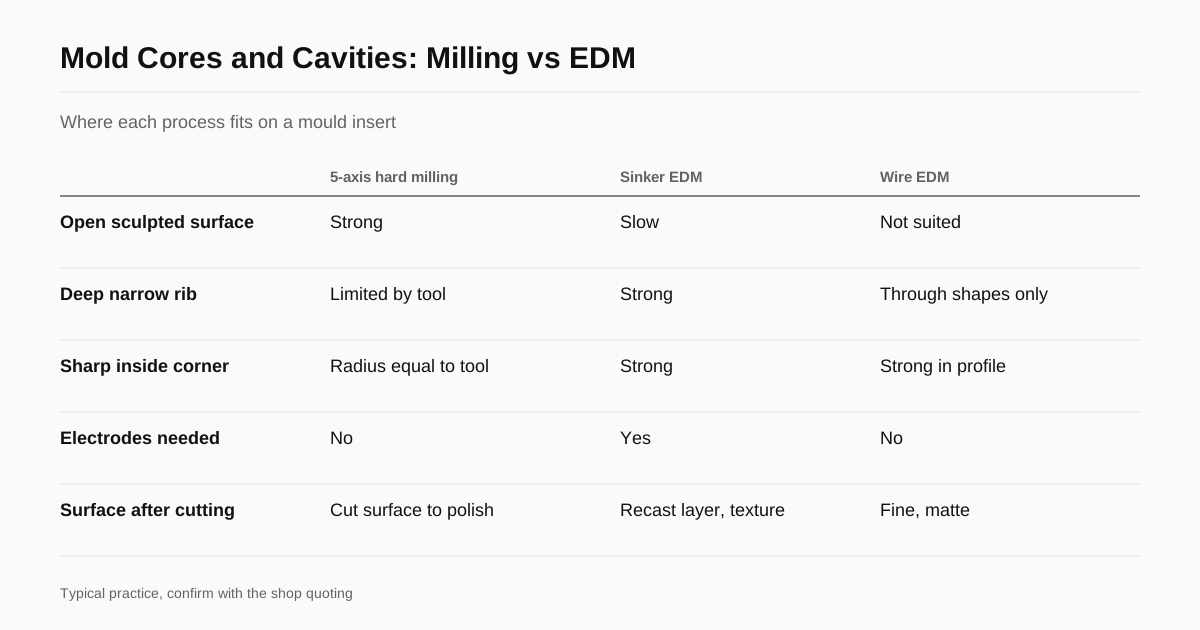
Injection mould cores and cavities carry the shape of the finished plastic part, so their surfaces must be accurate, clean and often polished. For decades the route was rough milling, heat treatment and then EDM for the fine detail and sharp corners. Modern 5-axis machines with stiff spindles and hard-milling tools have moved a large share of that work onto the milling machine. This article explains where 5-axis milling beats EDM, where it does not and what that means for an RFQ.
What cores and cavities need
A mould insert has several surface types, and each calls for a different treatment.
- Cavity and core faces. Sculpted or textured surfaces that form the part. They need accurate form and a controlled finish.
- Parting and shut-off surfaces. Flat or stepped faces where the two halves meet. Flatness matters to avoid flash.
- Ribs and deep slots. Narrow cavities that form ribs on the plastic part.
- Sharp internal corners. Where the design needs a corner with almost no radius.
- Ejector pin and slider holes. Drilled and reamed features that need position accuracy.
Steels and hardness
| Steel | Typical hardness | Typical use |
|---|---|---|
| P20 (1.2311, 1.2738) | About 30 to 36 HRC, supplied pre-hardened | General moulds, large cores |
| H13 (1.2344) | About 44 to 52 HRC | Long runs, abrasive resins, die casting |
| 420 type (1.2083) | About 48 to 54 HRC | Optical, medical and corrosive resin moulds |
| Maraging and others | Varies | Special insert uses |
Pre-hardened P20 can be milled to final size without heat treatment, and 5-axis machines handle it with ordinary carbide tools. Harder steels need the hard milling methods described in hard milling on 5-axis.
Where 5-axis milling beats EDM
Short tools in deep cavities. Tilting the tool or the part brings a short, stiff cutter close to the surface. A 3-axis machine would need a long slender tool that deflects. The tilted tool avoids the dead centre of a ball-nose cutter, giving a better finish.
No electrodes on open surfaces. Sinker EDM needs a copper or graphite electrode for each area, and each electrode must be designed, machined and checked. Hard milling goes straight from the model, which saves the electrode time and cost.
One setup for many faces. A 5-axis machine can cut the cavity, the parting surface and the pin holes in one clamping, so they keep a precise relationship.
Faster surface finishing. An evenly cut surface needs less polishing than an EDM surface, which has a recast layer and a texture that often needs removal on polished moulds.
Where EDM still wins
- Deep narrow ribs. A cutter has a diameter and a limited length. Ribs narrower than the smallest usable cutter, or deeper than a safe length to diameter ratio, need EDM.
- Sharp inside corners. A milling tool leaves a corner radius equal to its own radius. EDM leaves much sharper corners.
- Very hard materials. Above a certain hardness tool life becomes uneconomical.
- Fine textures. Some shops use EDM to create spark-eroded textures on purpose.
- Wire EDM for through shapes. Through-cut inserts, slider shapes and ejector openings are typically wire cut.
Most moulds use both. The 5-axis machine does the bulk of the cavity, and EDM finishes the corners and ribs. The balance depends on the part design, and a shop can often recommend design changes that move work from EDM to milling, such as adding a small corner radius. The principles are in design for 5-axis machining.
Comparison
| Point | 5-axis hard milling | Sinker EDM | Wire EDM |
|---|---|---|---|
| Open sculpted surface | Strong | Slow | Not suited |
| Deep narrow rib | Limited by tool | Strong | Only through shapes |
| Sharp inside corner | Radius equal to tool | Strong | Strong in profile |
| Electrodes needed | No | Yes | No |
| Surface after cutting | Cut surface, polish | Recast layer, texture | Fine, matte |
| Setups | Few | Many | Few |
Typical differences only, confirm with the shop.
Tolerance and finish
Mould inserts are commonly cut to tolerances of a few hundredths of a millimetre on the cavity form, with tighter figures on mating faces and fits. Finish is specified by polish grade or a texture standard. For polished surfaces, the machining finish should leave an even allowance, which the polisher removes. Writing finish targets on a drawing is covered in surface finish for 5-axis parts.
What drives the cost
- Steel type, size and hardness.
- Cavity depth and the smallest radius.
- Number of EDM electrodes avoided or still required.
- Polish grade or texture.
- Heat treatment and coating steps.
- Machine time on the 5-axis machine, which is billed at a higher rate than 3-axis.
Machining sequence for a mould insert
A typical route for a hardened insert runs like this.
- Saw or purchase the block, and machine the outer size with allowance.
- Rough machine the cavity in the soft or pre-hardened state, leaving stock.
- Drill cooling channels and ejector holes, which need position accuracy.
- Stress relieve or heat treat, if the steel needs it.
- Semi-finish and finish on the 5-axis machine, with hard milling if the steel is hardened.
- EDM the corners, ribs and slots that milling cannot reach.
- Polish or texture, then fit and test the tool.
If a shop gives you a process plan in this form, you can see where the money goes. A step list with times per operation is more useful than a single price.
Cooling channels and fit
Cooling channels are drilled in straight lines, so the position of channels relative to the cavity surface matters for cooling and for strength. A 5-axis machine can drill channels at angles to follow the cavity shape, giving more even cooling than a straight-only layout. Fit features, such as insert pockets and shut-off surfaces, need tight tolerances so that the tool closes without flash. Parting line match is checked by blueing and by measurement.
Design changes that save money
Small design changes often move work from EDM to milling. Adding a corner radius that matches a common cutter size removes the need for an electrode. Opening a narrow rib slightly makes it reachable by a milling tool. Splitting a deep cavity into two inserts can allow short tools on each. These changes belong to the tool designer, who knows what the plastic part needs, but a shop can propose them in a design review. Ask for that review when you send the model, and read design for 5-axis machining for more points.
What to send with the RFQ
- A 3D model of the insert, with the cavity and the parting plane.
- The steel grade and hardness.
- The smallest corner radius and the deepest rib.
- Surface finish or texture targets.
- Shot count the tool is designed for.
- Whether the shop is to make only inserts or also the complete tool.
Use the RFQ form and ask each shop for a process plan that shows what is milled and what is EDM.
Checklist
- Send the STEP model and the drawing of each insert.
- State steel grade and hardness.
- Mark features that must have sharp corners.
- Give polish grade or texture standard.
- Ask for the milling and EDM split in the quote.
Frequently asked questions
Can 5-axis machining replace EDM for molds?
On open surfaces and moderate cavity depths, often yes, because hard milling with a short tilted tool is faster and needs no electrodes. Deep narrow ribs, sharp inside corners and very small features still need EDM.
Which steels are used for mold cores and cavities?
Common choices are pre-hardened P20 at about 30 to 36 HRC, H13 at about 44 to 52 HRC, and corrosion-resistant 420-type steels for optical and medical moulds. Hard milling covers the harder range with suitable tools.
Does 5-axis make a mold cheaper?
It can cut the number of setups, remove electrode costs and reduce hand finishing. Savings depend on the geometry. A shop that has both processes will quote the cheaper route, so ask for the process plan.
Need a quote for this part?
Send the drawing. We match you with up to 3 5-axis shops and reply within 24 business hours.
Get matched with a 5-axis shop